Extract from Wikipedia Brahmanical Tradition Cosmogony and the Antediluvian history [ edit ] According to the Vedic traditions, human history proceeds in cycles, dependent on the evolutions and dissolutions of the world. Time is divided into four ages – Krita Yuga , Treta Yuga , Dvapara Yuga and Kali Yuga – collectively forming one Maha Yuga . Seventy-one Mahayugas form a Manvantara , a period of time over which a Manu presides. In each cycle, this Manu is the first man and also the first king and lawgiver. Every Manvantara has its own set of Indra , gods and seven sages. Fourteen Manvantara create a Kalpa (aeon) , after which the creation comes to a close in a periodical destruction called Pralaya . After that, the creation starts all over again in an endless cycle of evolutions and dissolutions. The traditions relate that the present Kalpa is called Varaha . Out of the fourteen manvantaras ...

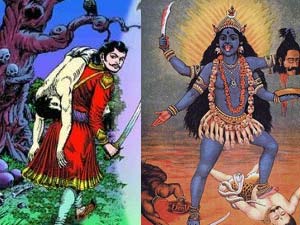
In India there are legends about a ruler called Vikramaditya considered to be the best Judge born on this planet Earth till now.The legend says that he was blessed by Goddess Kali and was given a Sword which would make him invincible in any battle and was blessed by Indra to rule for 1000 years and his brother Bhatti also was blessed by Goddess Kali to rule for 1000 years and they shared the responsibility of the ruling of the kingdom for 6 months.While Bhatti was ruling Vikram went to travel the country and know the pains and sufferings about his people.
Vikramaditya was considered to be the most wise person and a judge whom even the Devas in Heaven would respect.Indra called him to resolve a conflict and issue on who is the better dancer 1.Rambha or 2.Urvasi and both were very exceptional at Dancing and it was difficult to find any faults with their dance and decide who is the best.Vikram gave two garlands of flowers to both the Apsaras and asked them to dance and Urvashi was declared the winner as she danced without fear and the flowers garland in her neck remained fresh even after the dance while Ramba's flower garland became rotten to a certain degree because she danced with the fear that she might be defeated by Urvashi and this positive attitude and dancing for the sake of dancing without thinking about the results made Urvashi win the Dance competition.Indra awarded Vikramditya the boon to rule for 1000 years on Earth and also gave him a Salabhajika Throne which he can only sit on and only Dharma is held high upon in sitting on the Throne.
Vikramaditya has also resolved a conflict where 2 ladies bring a child and each claim that the baby is their child and he orders to cut the baby into two and give the half to each mother claiming the child and one lady says no please don't kill the child let the other lady have the child I just want the Child to be alive and happy and then Vikramaditya immediately understands that she is the real mother while the other lady is not the mother as any mother would not get her child killed at the expense of having a piece of the child and thus he unravels the false accuser and sentences her to prison and gives the child to the real mother.
Vikrmaditya also answers the very difficult questions on justice put by Betaal when he tries to bring him to offer him to Goddess Kali.I cannot elucidate each Betaal story but each one is like a Case Study in which only the person who is wise and a good judge can give correct judgement.
Today the pathetic nature of the judicial system and the criminal justice system and the law enforcement system which are mainly governed and led by people with personal interests. monetary pursuits and greedy people and people who misuse their power we can only say that in this country India there lived once a great judge whom even the Gods considered praiseworthy.


Comments
Post a Comment